


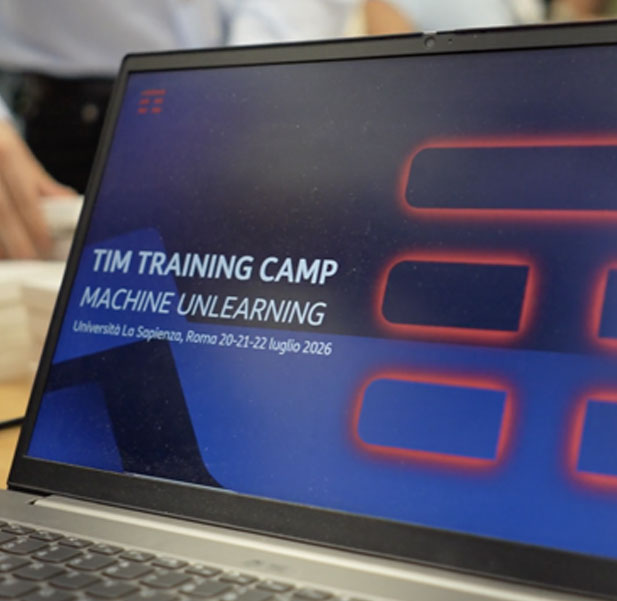
How do you teach artificial intelligence to forget? It is one of the new challenges facing AI, which must balance innovation, the protection of personal data and respect for users’ choices. This need gave rise to ‘Forgetting Users via Machine Unlearning’, the hackathon organised by TIM in collaboration with Sapienza University of Rome, aimed at around 100 students on the Master’s degree programme in Data Science.
For three days, the students worked side by side in small teams, tackling a real-world case study inspired by the challenges that companies and organisations face today in developing artificial intelligence systems.
At the heart of the hackathon was the theme of Machine Unlearning, an increasingly strategic area of research aimed at developing techniques capable of removing the influence of specific data from an already trained AI model. This provides a concrete response to increasingly pressing needs regarding privacy and data protection: when a user withdraws their consent, companies must be able to exclude their information from predictive systems without necessarily having to retrain the entire model – a process that often involves unsustainable time, cost and energy consumption.
Guided by TIM colleagues, the participants explored the technological context, analysed the problem and developed innovative solutions, drawing on their skills in data science, machine learning, problem-solving and teamwork. At the end of the challenge, the teams presented their projects to a panel comprising TIM experts and university lecturers, who awarded prizes to the most effective proposals.
For the students, it was an opportunity to tackle a real-world use case, collaborate with TIM professionals and experience a work approach based on innovation, collaboration and tangible impact. For TIM, it was an opportunity to engage with the talent of tomorrow and continue to build a bridge between universities and business, supporting the development of the skills that will drive the evolution of artificial intelligence.